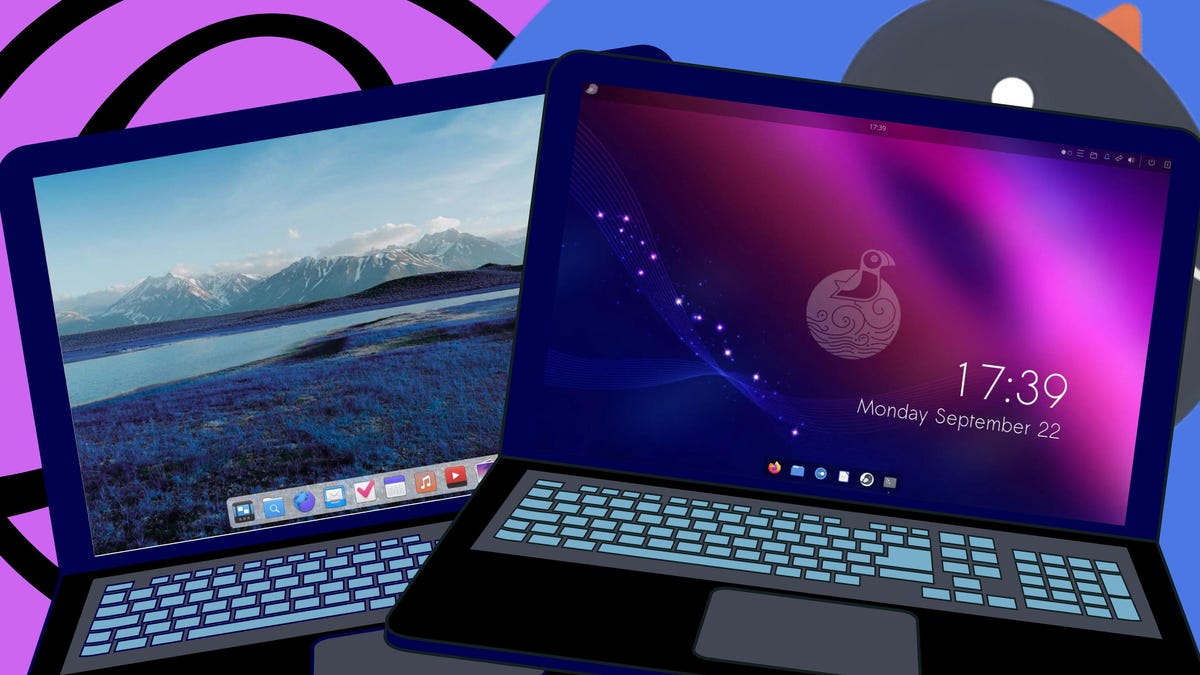

Observe ZDNET: Add us as a preferred source on Google.
ZDNET key takeaways
- elementary OS and Ubuntu Budgie are Linux distributions.
- Each of those distros are stunning and user-friendly.
- Certainly one of these desktop distros is extra versatile than the opposite.
I’ve a smooth spot in my coronary heart for each elementary OS and Ubuntu Budgie. For about 5 years, elementary OS was my Linux distribution of alternative. I discovered it charming, well-designed, environment friendly, and user-friendly. Quick ahead about 10 years, and Ubuntu Budgie usurped Pop!_OS for a few years.
Each of those desktop working methods ought to be thought of choices for these new to Linux and those that are effectively seasoned within the open-source OS. Upon first blush, these distributions look fairly totally different, however at their coronary heart, they’re fairly comparable.


Additionally: The best Linux laptops in 2025: Expert tested for students, hobbyists, and pros
Let’s check out every and decide which one is best for you.
elementary OS
elementary OS relies on Ubuntu LTS releases and was first launched in 2011. From its early days to the current, elementary OS has retained the same design scheme, and for many who understand it, you have most likely thought all alongside, “This appears to be like lots like MacOS.”
I imagine that was intentional. Provided that MacOS has been heralded for years as being one of many extra user-friendly working methods, it is sensible that elementary OS would resemble Apple’s OS.
Nonetheless, there’s one obvious distinction (aside from elementary OS being Linux): elementary OS outperforms MacOS by a protracted shot.
The minimal system necessities for the newest launch of elementary OS are as follows:
- A current Intel Core i3 or comparable dual-core 64-bit processor
- 4 GB of RAM
- 32 GB SSD with free house
- A 1024×768 minimal decision show
Alternatively, the minimal system necessities of MacOS Tahoe are a MacBook Air (2020 or later), MacBook Professional (2020 with 4 Thunderbolt 3 ports or 2021 or later), Mac mini (2020 or later), iMac (2020 or later), or Mac Professional (2019). These units ought to have not less than 16 GB of RAM and 50 GB (for set up solely).
In case you had been to put in elementary OS and MacOS Tahoe on equally powered machines, elementary OS would blow MacOS away. However what’s it about elementary OS that makes it so particular?
Additionally: My 10 favorite Linux distributions of all time, ranked
For one factor, the design scheme performs out in each aspect of the OS. From the dock to the desktop menu to the put in apps to the highest bar… the design is seamless and flows superbly from one bit to a different. Open the file supervisor, and it appears to be like like elementary OS. Click on the desktop menu… elementary OS. To be sincere, it is fairly refreshing in a world the place it is attainable to put in totally different apps utilizing totally different Widget toolkits on the identical desktop, inflicting a little bit of thematic variation.
Talking of theme: elementary OS is among the uncommon Linux distributions that I by no means really feel the necessity to tweak out of the field. That is saying one thing as a result of I at all times tweak my desktops. Nonetheless, the builders of elementary OS (and the Pantheon desktop) get it proper, launch after launch, and I’ve by no means felt it essential to make even the slightest change.
elementary OS additionally:
- Helps Flatpak apps
- Features a stunning multitasking view
- Helps sizzling corners and multi-touch gestures
- Has a user-friendly app retailer
- Features a function referred to as Safe Session, which requires apps to explicitly request permission for delicate actions.
- Has microphone/display screen recording indicators
- Locations a excessive precedence on privateness settings
- Has a really quick boot time
- Gives loads of accessibility choices
- Makes use of Flatpak for many app installs
Is elementary OS best for you?
Are you new to Linux? Are you migrating from MacOS? Would you like an working system that’s equal components simplicity, reliability, effectivity, and sweetness? If that’s the case, elementary OS ought to be your first alternative.
elementary OS is as charming as a desktop working system may be. The Pantheon desktop surroundings makes utilizing Linux as simple as attainable, so you will by no means really feel the necessity to even open the terminal app and use the command line.
Additionally: The most beautiful Linux distributions for 2025
There may be one caveat to utilizing elementary OS: it isn’t almost as versatile as different Linux distributions. The excellent news is that you simply most likely will not really feel the necessity to make any adjustments. Nonetheless, when you wish to tinker, elementary OS may not be the distribution for you.
Ubuntu Budgie
You would be hard-pressed to discover a prettier Linux desktop.
Jack Wallen/ZDNET
Ubuntu Budgie is an official Ubuntu “taste.” Because of the Budgie desktop, this distribution is as stunning as any in the marketplace. And due to Ubuntu, it is also user-friendly and has excellent {hardware} help (by the use of the {Hardware} Enablement kernel).
Out of the field, Ubuntu Budgie considerably resembles Home windows 10, with a chic panel, an easy-to-use desktop menu, a system tray, and all of the bits you have been accustomed to for years.
Additionally: Thinking about switching to Linux? 10 things you need to know
One of many massive variations (for me) between Ubuntu Budgie and elementary OS is that I at all times customise the Budgie desktop. I a lot choose a dock over a panel (which is simple to vary in Budgie), by no means use darkish mode, and tweak just a few different tidbits to make the desktop higher suited to my wants.
Happily, these configurations are all very simple to deal with, but it surely illustrated the important thing distinction between these two: Ubuntu Budgie is much extra versatile than elementary OS.
That is to not say that Budgie can do extra. No. What I imply is that Ubuntu Budgie can be extra. You need Budgie to appear to be Home windows? You bought it. Is the MacOS UI higher suited to your style? Have at it. Or possibly you would like one thing fully totally different? Make it so.
In different phrases, if you need a user-friendly, stunning, and customizable desktop, Ubuntu Budgie is your greatest wager.
Ubuntu Budgie:
- Gives a versatile format with a prime panel and backside panel (or dock)
- Has the Raven sidebar for notifications and applets
- Features a Welcome Middle for simple setup
- Gives varied layouts that may mimic Home windows, MacOS, or Chrome OS
- Consists of loads of customization choices for themes, icons, and panel settings
- Is predicated on Ubuntu LTS with the HWE kernel for large {hardware} help
- Gives auto window placement (tiling and snapping)
- Helps applets that may be added to the panel
- Helps set up through APT, Snap, and Flatpak
Is Ubuntu Budgie best for you?
This one is simple. If you would like a ravishing desktop that’s extremely configurable (and appears good in all of its incarnations), simple to make use of, presents excellent {hardware} help, and performs like a champ, then Ubuntu Budgie is what you need.
Which one must you select?
As I discussed, the most important distinction between elementary OS and Ubuntu Budgie is that the latter is much extra versatile and customizable. On the identical time, elementary OS is a kind of distributions that “simply works.”
Additionally: The top 2 Linux distros Windows 10 users are fleeing to right now – and why
So, if you need a distribution that you simply set up and use with out having to spend any time making it yours, go together with elementary OS. If you would like a distribution that means that you can do no matter you need with the desktop format, go together with Ubuntu Budgie.
Both manner you go, know that you’ve got chosen a winner.